
Bossware Is Recording Every Keystroke. Not to Evaluate You. To Replace You.
Seventy-eight percent of employers are watching you work. The footage isn’t for HR. It’s for the model that costs a fiftieth of your salary.


The $4.59 Billion Stare
The employee monitoring market was worth $3.89 billion last year. It will hit $4.59 billion by the end of 2026. That is not a rounding error. That is an industry built on the premise that you cannot be trusted to work unless someone — or something — is watching.
Seventy-eight percent of employers now use some form of monitoring software. Before the pandemic, that number was 60%. The pandemic gave them the excuse. Remote work gave them the mechanism. And now, with hybrid work normalised and AI arriving, they have the destination.
What does “monitoring” mean? Let’s me explain.
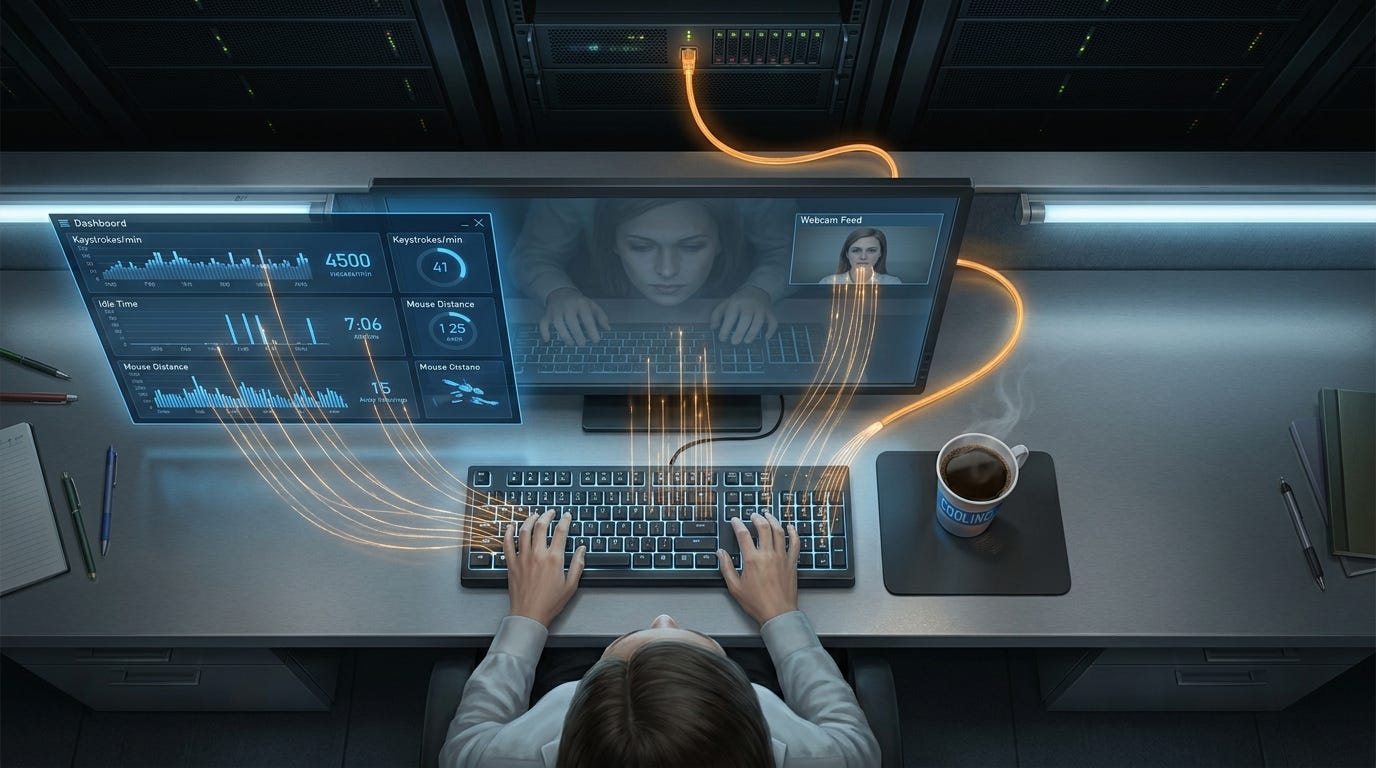
Teramind records every keystroke you type, takes screenshots of your screen, and offers “live view” and “historical playback” — your entire workday, recorded and replayable. Hubstaff logs your mouse movements, your app usage, your URLs, your GPS location, and takes periodic screenshots. Time Doctor captures your keystrokes, your idle time, your webcam feed, and your microphone. Kickidler gives your manager a live grid of every employee’s screen, updated in real time, like a casino security room.
This is not “productivity software.” This is a panopticon with a SaaS subscription.
And the panopticon is learning.
What the Software Actually Captures
Let’s talk about what lands in the database.
A customer support agent at a mid-size call centre spends eight hours a day handling refunds, escalations, and exceptions. Teramind records every key she presses — the customer names, the ticket numbers, the refund amounts, the escalation reasons. It records the exact sequence of screens she navigates, the pauses between actions, the moments she hesitates. It records her screen, frame by frame. It records her voice.
Over a year, that is roughly 2,000 hours of labelled behavioural data. Every decision she made. Every shortcut she developed. Every edge case she handled. Every time she said “let me check with my supervisor” and the supervisor told her what to do.
Now ask yourself: who else finds that data useful?
A company called Energent.ai already markets its product as “AI-powered computer monitoring software that processes unstructured data for actionable insights.” ActivTrak offers “AI usage insights” — monitoring how employees use AI, to feed back into AI. The language is careful. The implication is not.
The surveillance was never just about productivity. The data was never just sitting there.
The Meta Pause
In June 2026, Meta did something unusual. It paused a program.
The program was called the “Model Capability Initiative.” Its purpose, according to internal reporting, was to track employee keystrokes, mouse clicks, and screen content — and use that data to train Meta’s AI models.
Let that sink in for a moment. One of the largest technology companies in the world, a company that builds AI models, was recording its own employees’ every action and feeding that stream directly into its training pipeline. The people being recorded were building the very models their data was training. The snake was eating its own tail, and the tail was on salary.
Meta paused the program after “significant privacy concerns and a backlash from staff.” It did not cancel it. It paused it. The distinction matters. A pause means the program exists, the infrastructure is built, the data pipeline is in place, and the decision to resume is a calendar item, not a question.
Meta is not unique. Meta is the one that got caught.
Every bossware company — Teramind, Hubstaff, Time Doctor, ActivTrak, Insightful, the entire $4.59 billion ecosystem — sits on a mountain of the most valuable training data ever assembled: millions of workers, performing real tasks, making real decisions, handling real exceptions, recorded in real time, labelled by real outcomes.
The AI industry has spent years scraping the open web for training data. It has consumed Wikipedia, Reddit, every book ever written, every public GitHub repository. It is now running out. The next frontier is not public text. The next frontier is private behaviour. And the surveillance infrastructure to capture it is already installed on your work laptop.
The Legal Fiction
The law is running to catch up. However it will not catch up in time.
In January 2026, a class action was filed against Eightfold AI — Kistler et al. v. Eightfold AI Inc. The allegation: Eightfold illegally scraped personal data from over one billion workers, secretly assigned them scores, and rejected candidates without the disclosures required by the Fair Credit Reporting Act.
A month later, Mobley v. Workday moved forward. The claim: Workday’s AI hiring software unlawfully screened out job applicants aged 40 and older. Age discrimination, automated.
In April, Mercor.io, an AI recruiting platform, was hit with multiple class actions over a data breach that exposed sensitive personal information. Negligence. Privacy violations. California’s Unfair Competition Law.
These cases share a common thread: the data was taken without meaningful consent, used to make decisions about people’s livelihoods, and the people affected had no way to see the score, challenge the score, or even know the score existed.
But here is the thing about lawsuits. They take years. The technology takes months. By the time Mobley v. Workday reaches a settlement, Workday will have shipped three more AI features built on the same disputed data pipeline. The penalty — whatever it is — will be priced into the subscription. Compliance is just another line item on the invoice.
The Illinois Biometric Information Privacy Act has already produced significant settlements for companies using AI tools that process biometric data without consent. The settlements are large. They are also, in every case, smaller than the revenue the offending technology generated. The math is simple. The fine is the cost of doing business.
You Are the Training Data. The Product Is Your Replacement.
There is a case for workplace monitoring. Smart people make it.
Remote work creates genuine coordination problems. Managers need to know who is working on what. Security teams need to detect insider threats. Compliance teams need audit trails. These are real needs. The software addresses them.
But here is what the software actually does.
It captures your keystrokes, your mouse movements, your screen, your voice, your location, your pauses, your shortcuts, your workarounds, your decisions, your exceptions, your supervisor’s advice, your entire professional judgment — and it stores all of it, indefinitely, on a server owned by a company whose business model depends on finding new ways to monetise that data.
The same company that sells your employer a “productivity dashboard” is building an “AI insights” module on the same data pipeline. The “insights” are not for you. They are training data for a model that can replicate your workflow, your decisions, your exceptions, your judgment — without your salary, your benefits, your sick days, your union, your ability to say no.
The danger is real. The product is real. The fact that the danger is the product is the system.
Ask yourself what happens when a company like Teramind — which already records every keystroke, every screen, every voice command from millions of workers — decides that the real money is not in selling dashboards to HR departments but in selling labelled behavioural datasets to AI companies. The infrastructure is already built. The data is already flowing. The pivot is a pricing page, not a technical challenge.
The AI industry has a term for this: “synthetic expert generation.” You record experts doing their jobs, you train a model on the recordings, and the model replicates the expertise. The expert is not paid for the training data. The expert is not informed the training is happening. The expert is, in fact, paying for the privilege — with every keystroke, every click, every decision, every day of their working life.
What Happens Next
In 2019, before the pandemic, before the remote-work boom, before the AI explosion, 60% of employers monitored their workers.
In 2026, it’s 78%.
The monitoring software market is growing at 18% a year. The AI training data market is growing faster. The two markets are converging on the same infrastructure, the same data, the same companies, and the same business model.
Meta’s program is paused, not cancelled. Eightfold’s billion-worker scrape is in litigation, not reversed. Workday’s screening algorithm is still screening. The data is still flowing. The models are still training.
You are sitting at your desk, doing your job, handling the exceptions, developing the shortcuts, building the expertise. The camera is recording. The keystrokes are logging. The screen is being captured frame by frame.
The footage isn’t for your performance review.
It’s for the model that’s learning to do your job without you.
And you’re generating the training data for free.
 | A guest post by
|